Pragmatism, Integrity, Passion

Pragmatism, Integrity, Passion

Do you struggle to pick the right steel pipe for your pipeline project? A wrong choice wastes money and causes safety risks. We can help you make the right choice. The main difference between erw vs lsaw pipe is the welding method and size. ERW uses electric resistance for smaller, thinner pipes. LSAW uses submerged arc welding for large-diameter, thick-walled pipes. You choose ERW for cost-effective low-pressure lines and LSAW for high-pressure harsh environments.
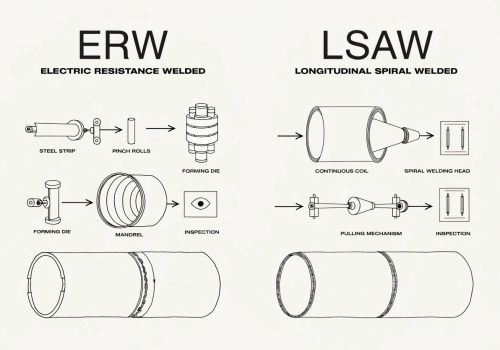
You might think all welded pipes are the same, but the differences are huge. Let us look closer at how these two pipe types work so you can buy with confidence.
Are you confused by different welding terms? Misunderstanding the production process leads to bad purchasing decisions. Let us break down how factories make these two pipes. ERW (Electric Resistance Welded) pipe uses hot-rolled steel coils and high-frequency current to melt the edges together. LSAW (Longitudinally Submerged Arc Welded) pipe uses single medium-thick steel plates. The factory bends the plate into a cylinder and welds it under a layer of flux.
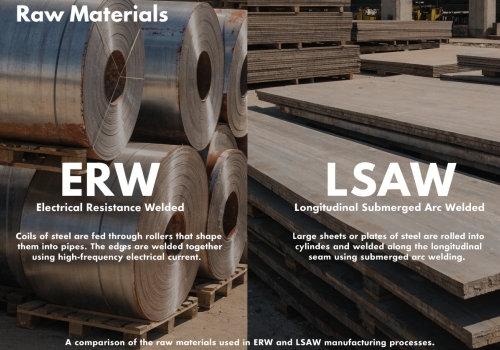
To truly understand erw vs lsaw pipe, you must look at the raw materials. I have seen many buyers ignore this step. ERW pipe production is a continuous process. We feed steel coils into a machine. Rollers shape the coil into a tube. Then, electric current heats the edges. They press together without any filler metal. This makes the weld very short and clean. It is fast and cheap. However, LSAW pipe production is a single-piece process. We take one thick steel plate. We press it into a U shape, then an O shape. We weld the inside and outside with a filler wire. This method is slower. But it handles much thicker steel.
You can see the clear differences in the table below.
| Feature | ERW Pipe | LSAW Pipe |
|---|---|---|
| Raw Material | Hot-rolled steel coils | Single thick steel plates |
| Welding Method | High-frequency electric resistance | Submerged arc welding with filler metal |
| Production Speed | Very fast, continuous | Slow, single pipe at a time |
| Weld Appearance | Almost invisible, smooth | Visible weld bead, very strong |
Do you worry about pipeline failures under pressure? A weak pipe will break and ruin your project. You must match the pipe strength to your system pressure. ERW pipes handle medium to low pressure up to 10MPa. Their weld toughness is slightly lower. LSAW pipes handle medium to high pressure above 16MPa. After heat treatment, LSAW weld toughness matches the base metal, making them perfect for extreme stress and harsh environments.
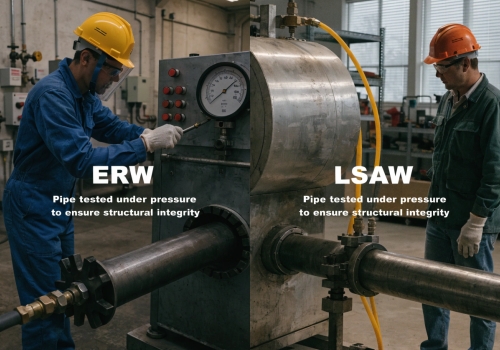
The core performance of erw vs lsaw pipe dictates where you can use them safely. Let me share a story from our company, Centerway Steel. Last year, we supplied an EPC oil and gas project in Nigeria, Africa. The client initially wanted to buy large quantities of ERW pipes to save money. The pipeline had to cross a long distance with very high internal pressure. I checked their CAD designs and pressure requirements. I told them that ERW pipes could not handle the 18MPa pressure in their main line. The weld area of an ERW pipe is strong, but LSAW is much safer for high-pressure oil transport. We supplied them with high-quality LSAW pipes for the main pressure lines, and ERW pipes for the low-pressure distribution network. This one-stop solution saved them money and guaranteed safety.
Here is a quick look at the performance limits.
| Performance Item | ERW Pipe | LSAW Pipe |
|---|---|---|
| Diameter Range | Small to medium (up to 610mm) | Large diameter (up to 1422mm or more) |
| Pressure Limit | Low to medium (≤ 10MPa) | Medium to high (≥ 16MPa) |
| Weld Toughness | Slightly less than base metal | Close to base metal after treatment |
| Environmental Use | Normal city environments | Extreme cold, deep sea, high stress |
Are you unsure which pipe fits your specific application? Using the wrong pipe causes delays and wastes your budget. Knowing the best application areas solves this problem fast. You should use ERW pipes for urban gas networks, water supply, and low-pressure fluid transport where cost matters. You should use LSAW pipes for long-distance oil and gas lines, pressure vessels, offshore platforms, and structural engineering projects that face extreme weather and high stress.
As an EPC purchasing manager, your main goal is to balance cost and quality. ERW pipes are very popular in city infrastructure. Because they have a high dimensional accuracy and a smooth surface, they are easy to install in tight city spaces. You can use them for water pipes, building structures, and low-pressure gas lines. They are cheap to buy in large batches. However, when you work on major energy projects, LSAW pipes are mandatory. LSAW pipes have excellent low-temperature resistance and corrosion resistance. If you build an offshore drilling platform or a high-pressure chemical plant, you cannot risk a leak. LSAW pipes offer the thick walls you need.
Use this simple table to match your project needs.
| Application Field | Recommended Pipe Type | Primary Reason |
|---|---|---|
| Urban Water & Gas | ERW | Cost-effective, good for low pressure |
| Offshore Oil Rigs | LSAW | High corrosion and pressure resistance |
| Building Columns | ERW or LSAW | ERW for small loads, LSAW for heavy loads |
| Cross-Country Oil Line | LSAW | High toughness, large diameter support |
Choosing between ERW and LSAW pipe depends on your project diameter, pressure, and environment. We provide both options to give you a safe, one-stop pipeline solution.



 English
 Español